

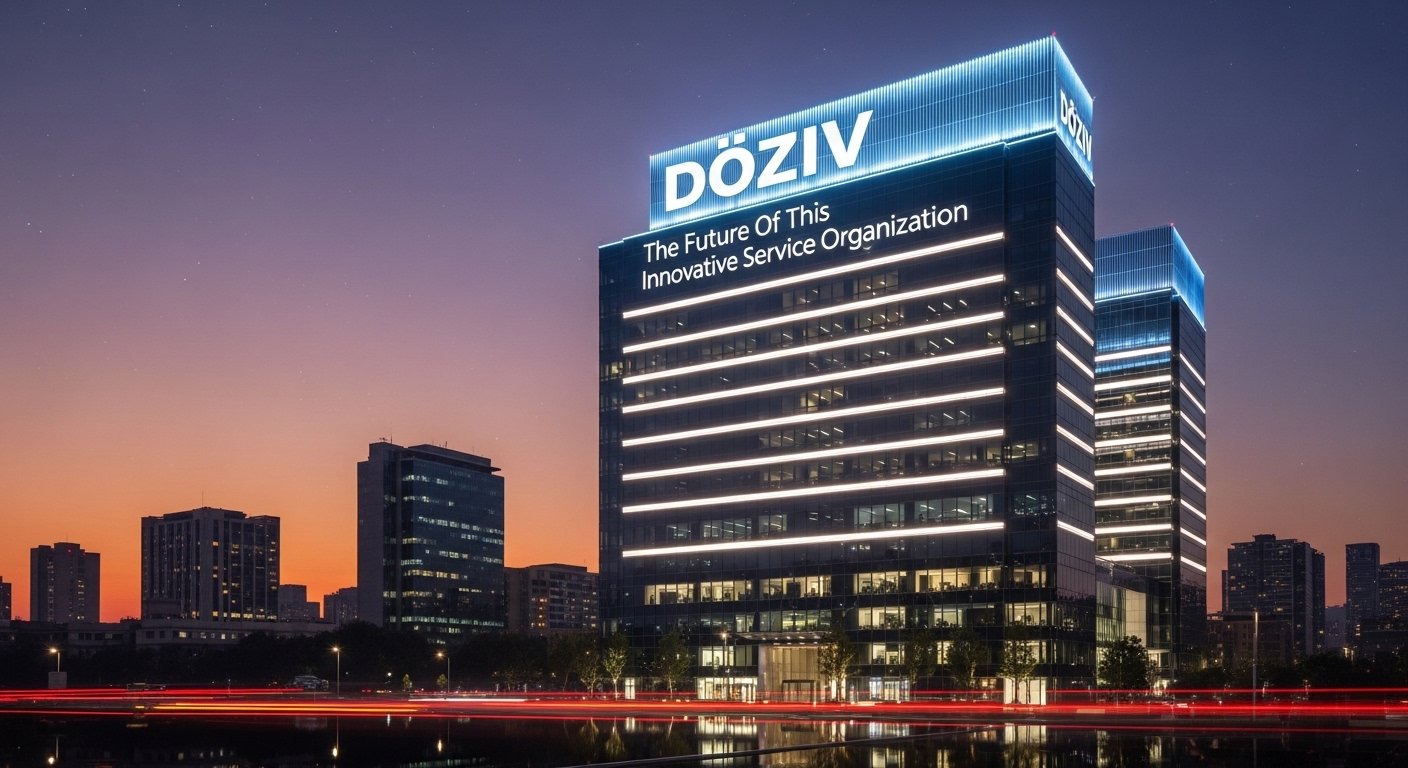
On a rainy Thursday evening in Berlin, a founder I had been tracking for months leaned back in his chair and asked a deceptively simple question: “What if service organizations stopped reacting and started predicting?” That conversation, held in a co-working space humming with early-stage ambition, was my first introduction to Döziv.
At first glance, Döziv looks like another ambitious entrant in the crowded service innovation landscape. But spend time with its leadership, its clients, and the ecosystem forming around it, and a more nuanced story begins to unfold. This is not just about operational efficiency or incremental improvement. It is about redesigning how service organizations think, adapt, and deliver value in a world defined by volatility.
For entrepreneurs, founders, and technology leaders, the emergence of Döziv raises a larger question: what does the next generation of service organizations actually look like?
Rethinking the Modern Service Organization
The traditional service organization was built for stability. Predictable demand, linear processes, and clearly defined customer journeys formed the backbone of operational design. For decades, this model worked.
Today, it no longer does.
Markets shift overnight. Customer expectations evolve in real time. Technology cycles compress from years to months. Service businesses that once relied on reactive support models now face pressure to anticipate needs before clients articulate them.
Döziv positions itself at the center of this transformation. Instead of operating as a conventional service provider, it functions as an adaptive layer between businesses and their customers. Its model blends data intelligence, operational design, and strategic advisory into a single framework. The result is not just improved service delivery but a redefinition of service itself.
Where legacy firms focus on ticket resolution and response time, this organization focuses on systemic redesign. That distinction may sound subtle, but in practice it changes everything.
The Architecture Behind Döziv
To understand why Döziv is gaining attention among founders and enterprise leaders, it helps to examine its core architecture. At its heart is an integrated service model built around three pillars: predictive analytics, modular operations, and embedded strategy.
Predictive analytics allows the organization to identify patterns in customer behavior, operational bottlenecks, and emerging risks. Instead of responding to issues after they arise, teams are equipped to act preemptively.
Modular operations enable flexible scaling. Rather than rigid departments, service units are designed as configurable modules. This makes it possible to reassemble teams quickly around evolving business priorities.
Embedded strategy ensures that service is not treated as a cost center but as a strategic driver. Consultants and technologists work alongside client leadership to align service delivery with long-term growth objectives.
The following table illustrates how this approach differs from traditional service organizations:
| Dimension | Traditional Service Model | Döziv Model |
|---|---|---|
| Operational Structure | Fixed departments | Modular, reconfigurable units |
| Customer Engagement | Reactive support | Predictive, proactive engagement |
| Data Utilization | Reporting and metrics | Real-time analytics and foresight |
| Strategic Integration | Separate advisory layer | Embedded within operations |
| Scalability | Linear growth | Elastic and adaptive scaling |
For founders evaluating service partners, these differences are not cosmetic. They determine speed, resilience, and long-term competitiveness.
Why Entrepreneurs Are Paying Attention
In conversations with early-stage founders, one theme consistently emerges: the fear of scaling inefficiency. Growth is exhilarating, but it exposes operational cracks. Customer service teams get overwhelmed. Internal communication fragments. Data becomes siloed.
Döziv appeals to entrepreneurs because it addresses these pain points before they metastasize.
By embedding analytics directly into service workflows, it allows startups to maintain clarity even as complexity increases. Instead of layering more staff onto broken processes, founders can reengineer the system itself.
This is particularly relevant in sectors such as fintech, health technology, and SaaS, where regulatory pressure and customer trust are paramount. A single service failure can erode credibility built over years.
What makes this organization distinct is its insistence that service excellence is not a downstream function. It is a strategic asset that influences brand perception, retention, and even valuation.
Technology as an Enabler, Not a Crutch
Many service firms advertise technology integration. Few genuinely integrate it.
Döziv’s model avoids the trap of tech for tech’s sake. Artificial intelligence and automation are treated as accelerators rather than replacements for human judgment. Algorithms identify patterns and suggest actions, but final decisions remain contextual and human-centered.
This balance matters. Over-automation can alienate customers. Under-automation can suffocate teams.
By designing workflows where technology handles repetitive analysis and humans focus on nuance, the organization achieves both efficiency and empathy. In an era where customer experience defines brand loyalty, that combination is rare.
Cultural Design as Competitive Advantage
Service innovation is not solely a technological challenge. It is cultural.
Inside Döziv, teams operate with a philosophy that resembles a startup more than a conventional consultancy. Cross-functional collaboration is standard practice. Data scientists sit beside operations specialists. Strategists engage directly with client support teams.
This cultural integration reduces friction. When insights move freely across disciplines, decision cycles shorten. Ideas are tested quickly. Feedback loops tighten.
For founders observing this model, there is a lesson beyond outsourcing service operations. Culture can be engineered. And when it is, performance follows.
Navigating Risk in an Uncertain Economy
Economic volatility is no longer an anomaly. It is a constant.
In such an environment, service organizations must serve as stabilizers. Clients expect continuity even when markets fluctuate. They expect insight when uncertainty rises.
Döziv’s predictive infrastructure provides early signals about demand shifts and operational stress points. This enables clients to adjust resource allocation before disruption escalates.
For example, a technology startup experiencing rapid user growth can preemptively scale support capacity using modular units rather than scrambling after service levels drop. Conversely, during demand contraction, resources can be reallocated without dismantling entire departments.
This elasticity reduces both financial risk and reputational damage.
The Strategic Implications for Founders
For entrepreneurs building companies in 2026 and beyond, the implications are significant.
Service is no longer a peripheral function. Investors scrutinize customer retention metrics as closely as revenue growth. Churn signals systemic weakness. Poor support erodes lifetime value.
Organizations like Döziv recognize that service data is not merely operational. It is strategic intelligence. Patterns in customer inquiries reveal product flaws. Escalation trends expose user confusion. Feedback loops inform roadmap decisions.
By integrating service analytics into executive decision-making, founders gain a clearer view of their market. They see not only what customers buy but why they stay or leave.
That clarity can shape product development, marketing strategy, and long-term positioning.
Scaling Beyond Borders
Global expansion introduces additional complexity. Cultural nuances influence customer expectations. Regulatory frameworks differ. Time zones complicate coordination.
Traditional service organizations often struggle to maintain consistency across regions. Processes that work in one market falter in another.
Döziv addresses this through localized modules within a unified framework. Core standards remain consistent, but execution adapts to regional realities. This hybrid model preserves brand coherence while respecting local context.
For scale-ups entering new markets, such flexibility can mean the difference between smooth expansion and costly missteps.
Measuring What Matters
Metrics define behavior. If organizations measure only response time, teams optimize for speed. If they measure satisfaction, they optimize for experience.
Döziv encourages a broader metric framework that includes predictive indicators. Instead of focusing solely on what happened, leadership examines what is likely to happen.
This forward-looking measurement culture shifts organizational mindset. Teams think in probabilities rather than postmortems. Leaders prioritize resilience alongside efficiency.
In practice, this means fewer surprises and more deliberate growth.
Challenges and Critical Questions
No innovative model is without challenges.
Embedding strategy within operations requires trust. Clients must be willing to share sensitive data. Leadership alignment is essential. Without executive buy-in, even the most advanced system stalls.
There is also the question of scalability. As demand for adaptive service models increases, can the organization maintain its cultural cohesion and analytical rigor?
These are open questions. Yet they reflect the same pressures facing every modern enterprise. The difference is that this organization confronts them directly, rather than deferring them.
The Broader Industry Shift
What makes the rise of Döziv particularly compelling is that it signals an industry-wide shift.
Service organizations are no longer back-office utilities. They are strategic partners in growth, resilience, and innovation. Technology has dissolved the boundaries between operations and insight. Data flows continuously, reshaping decisions in real time.
Founders who recognize this shift early will gain a competitive edge. Those who cling to outdated service structures risk falling behind.
The transformation underway is not incremental. It is structural.
Conclusion
Döziv represents more than an innovative service organization. It reflects a broader evolution in how businesses design, measure, and deliver value. By blending predictive analytics, modular operations, and embedded strategy, it challenges the reactive norms that have defined service for decades.
For entrepreneurs and technology leaders, the lesson is clear. Service is no longer a cost center to be optimized quietly in the background. It is a strategic frontier. Those who treat it as such will build companies that are not only efficient but resilient, insightful, and future-ready.
In an economy defined by uncertainty, adaptability becomes the ultimate advantage. Organizations that anticipate rather than react will shape the next chapter of business. Döziv is an early signal of that future.